Video · 10:25 ·
Why the Bayesian Sank in 15 Seconds: The Official Report, Animated
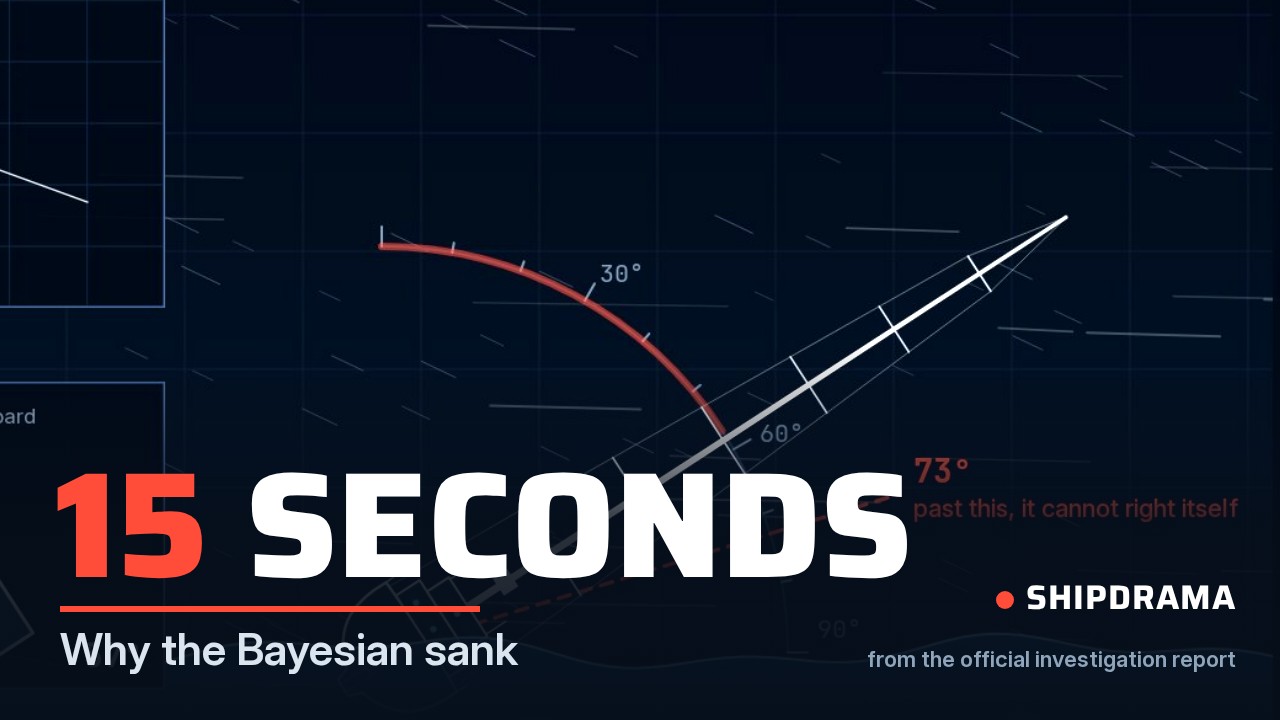
Pressing play loads the player from YouTube; nothing is loaded from it before that.
At 03:44 on 19 August 2024 the watch on the sailing yacht Bayesian logged the wind at 8 knots. Twenty-two minutes later a gust of about 70 knots knocked the 56-metre yacht onto its side in under 15 seconds, at anchor, with no sails set. It sank in 50 metres of water off Porticello, Sicily. Seven of the 22 people on board died.
This is a reconstruction of what the UK Marine Accident Investigation Branch found in its final report, published in November 2026: why a yacht with no sails up could be blown flat, why it could not come back past 73 degrees, why nobody on board knew, and why no liferaft floated free.
Source report
Chapters
Transcript
0:00 Intro
This is shipdrama. Maritime incidents, reconstructed from the official reports.
0:10 The Bayesian, 19 August 2024
The sailing yacht Bayesian. Porticello, Sicily, the 19th of August 2024. At anchor before dawn, with no sails set, the 56-metre yacht was knocked onto its side by a sudden, violent wind. It flooded and sank in 50 metres of water. Seven of the 22 people on board died.
At sixteen minutes to four on the morning of the 19th of August 2024, a deckhand on watch films a thunderstorm moving in over the north coast of Sicily. The deckhand posts the video, closes three hatches against the rain, and writes the wind speed in the log. Eight knots.
Twenty-two minutes after that post, the yacht is lying on its side.
About eighteen minutes later it is on the seabed, fifty metres down. Seven of the twenty-two people on board are dead.
This is what Britain's Marine Accident Investigation Branch found, in its final report.
In this video: the yacht, the night it anchored, the eleven minutes before, the knockdown itself, and why it could not come back.
1:28 The yacht and its 72-metre mast
Bayesian was a fifty-six metre sailing yacht, built in Italy in 2008. It carried a single aluminium mast that stood seventy-two metres above the water, more than twice the height of the mast on the vessel anchored beside it that night. The builder made other yachts of this size. They had two masts. Bayesian was the only one built with one.
Under the hull was a fixed keel, and inside it a centreboard: fifty-two tonnes of lead that could be lowered to give the yacht a draught of almost ten metres under sail. At anchor, the crew kept it raised. Lowered, it made the yacht swing and snatch at its anchor chain.
2:18 The evening: forecast and night orders
On the 18th, with a westerly wind forecast to build, the master moved the yacht twenty-five miles west to Porticello and anchored at 9:24 in the evening, east of the harbour breakwater. The guests were to go ashore in the morning.
The forecast spoke of winds of force three to five, and thunderstorms. There was no weather warning for the area. Before going to bed the master left an order with the night watch: wake me if the wind passes twenty knots, or if the anchor drags.
By half past midnight the last guest had gone to bed.
At one o'clock, and again at three, the watch noted the wind. Eight knots.
3:08 Eleven minutes
At 3:52, the master of the neighbouring vessel photographs Bayesian sitting quietly at anchor. The weather, the report says, stayed benign until about eleven minutes before the knockdown.
3:55. The wind is suddenly thirty knots, on the port bow.
3:57. Both vessels begin to drag their anchors. Bayesian leans ten to twenty degrees to starboard.
Four o'clock. The deckhand wakes the master. The rest of the crew are getting up, woken by the motion. The chief engineer starts the pumps to make the yacht ready to move. The master means to turn the bow into the wind. Nobody wakes the guests. There seems to be no need. The yacht is dragging to the south-south-east, and the land in that direction is five miles away.
4:08 The knockdown, in real time
At six minutes past four, as the master prepares to manoeuvre, the wind jumps to about seventy knots. The awning over the flying bridge rips from one side to the other.
Then the yacht goes over. Ninety degrees to starboard, in less than fifteen seconds.
The generators stop. Emergency lights come on. Until this moment, no water has come in. Now, with the yacht on its side, the sea comes over the rails and down the stairwells.
4:50 Why it could not right itself
Why did it not come back up?
Every sailing yacht has an angle beyond which it will not right itself. For Bayesian that night, the investigators calculated it at seventy-three degrees.
The building code asked for ninety, and allowed less on a large yacht fitted with a system that spills wind from the sails automatically. Bayesian had that system. It could only help with sails set.
With no sails set, the mast itself was the sail. The bare mast produced more than fifty-six per cent of the force pushing the yacht over, and the furled sails more than another twenty.
The investigators' estimate: a gust of sixty to sixty-eight knots on the beam was enough. And a wind strong enough to lean the yacht to thirty-six degrees was strong enough to take it all the way.
Nobody on board knew this. The yacht's vulnerability to wind with no sails set had never been assessed. In the report's words, the crew were unaware of a critical risk to the vessel.
Two details are hard to read. Keeping the centreboard up made the anchor less likely to drag. It also made the yacht easier to knock down. And the master's last decision, to turn into the wind, was the right one. There was not enough time to finish it.
6:23 Escape and rescue
Inside, the floor is now a wall. Two guests who were already awake pull out the drawers of the cabin furniture and climb them like a ladder.
They are the only people to get out of the guest cabins.
In the wheelhouse, three of the crew are in a shrinking pocket of air behind a closed door. An injured guest, outside, helps them force it open.
The chief officer, swept into another air pocket in the saloon, dives, and after several attempts opens the sliding doors and swims clear.
The yacht carried four liferafts. Their releases all worked, and none floated free: the cradles were designed for a yacht that sinks upright.
The chief officer swims back, frees one by hand and tows it to the others. By 4:24 it is inflated. Fifteen people board it, one of them a baby.
From the raft, they watch the bow rise and the yacht go under.
The engineer fires a red flare at 4:34. The wind carries it sideways. A second goes up at 4:43.
The crew of the neighbouring vessel, who had thought Bayesian had left the anchorage to avoid the storm, send their tender.
Seven people did not survive.
Jonathan Bloomer and Judy Bloomer. Chris Morvillo and Neda Morvillo. Mike Lynch, and Hannah Lynch, who was eighteen.
And the yacht's chef, Recaldo Thomas, last seen in the galley, greeting his crewmates as they passed.
8:26 What changes
What was the wind? Most likely a downburst, the report concludes: a column of air that falls out of a thunderstorm and spreads across the surface in a straight line.
Some survivors saw what looked like a waterspout, and the investigators could not rule one out. But both vessels dragged in a near-straight line. And two miles away, an official weather station logged an average wind for that hour of under three knots.
The forecast was broadly right. It did not say that the thunderstorms it predicted could do this.
The investigators did not have everything. An Italian criminal investigation restricted their access to witnesses and to evidence, and they say their account may change if what was withheld is disclosed. The report does not assign blame. That is not its purpose.
It makes seven recommendations. Study how vulnerable large sailing yachts are with no sails set. Change the code. Tell crews how to prepare for extreme weather, under way or at anchor. Stow liferafts so that they float free from a yacht on its side. Teach officers to recognise downbursts. And find a way for forecasts to carry hazards that are rare and violent.
At 3:52, a photograph shows a yacht at rest. Fourteen minutes later it was on its side.
10:01 Sources and credits
This reconstruction follows the investigators' own report, and nothing else. The full report is linked below.
If you want the next one, subscribe. Sources and corrections are at shipdrama.com.
Credits
Every figure, time and quotation comes from the report above. All drawings are our own reconstructions from its text and figures; hull shapes, diagrams and interiors are schematic. Harbour map: © OpenStreetMap contributors. Coastline: Natural Earth. Narration is a synthetic voice. Music: shipdrama.